Connecting robots to Choreographer
Robots can either be connected to Choreographer before starting the application or dynamically connected and disconnected from the application once it is running.
Connecting robots before starting the Application
To connect your robot, start Choreographer from the command line with arguments:
--hostname {IP/Hostname of your Spot} --user {Username you use to log in to your Spot} --password {Password for your Spot}
To connect multiple Spots at once include additional command line arguments, one set for each Spot.
--nickname {description for identifying your Spot} can also optionally be appended to the above command line argument list for each connection to automatically populate the “Nickname” column.
Connecting robots after starting the Application
To connect your robot after the application has been started
Select the Robot Management Tab (shown in the image below)
Click the Add Robot button. Enter the robot’s hostname, username, and password.
To remove robot connections, click Disconnect Robot(s) and check any robots that you want to disconnect. Note: Disconnecting from a robot will power off the robot and release the lease and E-Stop.
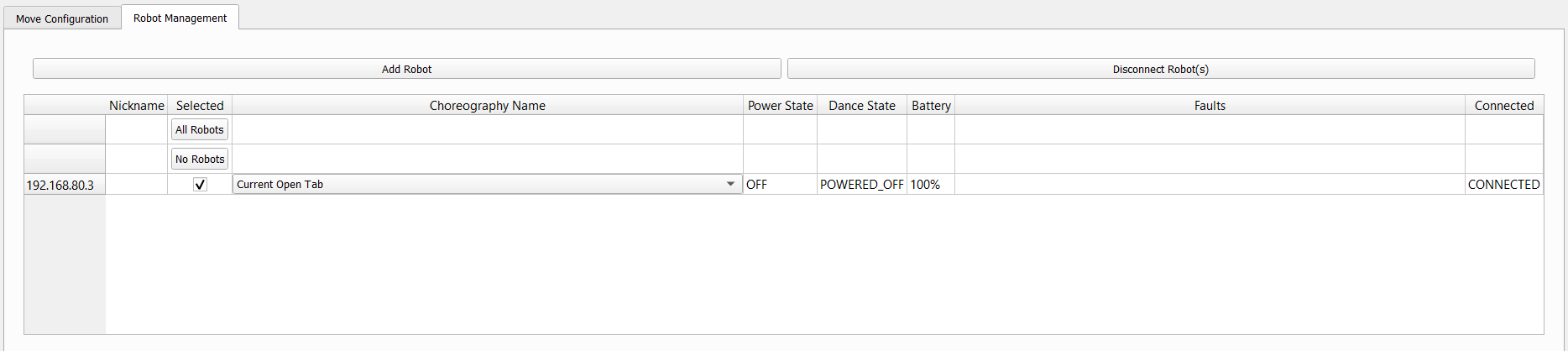
Choreographer supports connections to multiple robots. In the Robot Management Tab, you can select which robots are being controlled at a given time. Additionally, you can apply different choreographies to each robot and start them all at the same time.
Robot controls

Most buttons in the Robot Controls bar are disabled if there are no robots connected to Choreographer. If a robot(s) is connected to Choreographer, the buttons will have the following effects:
| Button | Function |
|---|---|
| Power Off | Powers off Spot's motors. Always press Power Off before approaching the robot. |
| Power On | Powers on your Spot’s motors. You must activate this before your Spot can stand or start choreography. |
| E-Stop | Enables or disables your Spot’s E-Stop. In an emergency, use this to stop the Spot immediately. |
| Self-Right | If your Spot has fallen, self-righting causes the robot to attempt to return to the sitting pose. |
| Sit | Sits the Spot in-place. Cancels all current choreography and music. E-Stop and Power Off can still be used in an emergency. |
| Roll Over | Spot will sit and then roll onto its side and power off, positioning itself so the battery can be easily removed. |
| Stand | Brings Spot to a stand. Cancels all current choreography and music. E-Stop and Power Off can still be used in an emergency. |
| Retro Log | Record a Retro Log. Retro Logs will record data from the previous minute of robot(s) operation. These logs can be downloaded from Spot's Admin Console on Web and then sent to Boston Dynamics Support for help resolving any issues with your Spot. |
| Start/Stop Experiment Log | Record an Experiment Log. Experiment Logs will record up to 5 minutes of ongoing robot(s) operation. These logs can be downloaded from Spot's Admin Console on Web and then sent to Boston Dynamics Support for help resolving any issues with your Spot. |
| Joystick Walk | Activates joystick controls (see Joystick controls section) |
| Enable WASD Driving | Activates WASD keyboard driving (see WASD Controls section) |
| Return To Start | Spot walks from its current location to the last location it started a dance (either a full choreography or the move preview dance). |
| Start Choreography | Sends the selected choreography sequence to the robot, with a command to execute the sequence at the set start time in the future (default 3 second delay). |
| Stop | Interrupts any active commands and freezes Spot in its current position. Music will also stop. EStop and Power Off can still be used in an emergency. |
Note: Return to Start brings all selected robots back to their starting position after completing a choreography. If multiple robots are being controlled, obstacle avoidance is enabled when they are navigating back to the starting position. To adjust this obstacle padding distance (in meters) the command line argument --obs-padding DIST_IN_METERS can be added to the Choreographer command line, or the set directly in the Robot Operation section of the Settings->Preferences menu.
Joystick controls
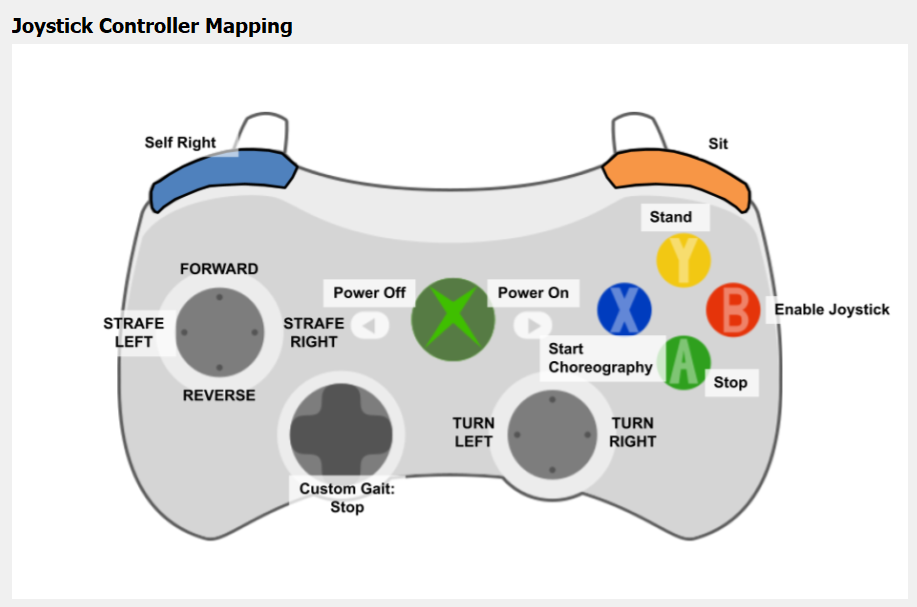
An Xbox gamepad controller can be used with the GUI for moving and positioning the robot. The button layout is set up for Xbox 360 controllers. Xbox controllers are connected to a computer using a USB port. Many of the buttons in the GUI are linked to gamepad buttons, and the gamepad button will behave the same as the corresponding GUI button. As shown in the diagram above they are:
| Button | Function |
|---|---|
| A | Stop |
| B | Enable joystick |
| X | Start choreography |
| Y | Stand |
| Left-Bumper | Self-right |
| Right-Bumper | Sit |
| Start | Power on |
| Back | Power off |
| DPad-Down | When a Custom Gait is in progress, finish the active gait and continue on to the rest of the sequence |
When the joystick is enabled by tapping the B button on the gamepad or using the GUI button, the robot walks and can be driven using the joysticks. As shown in the diagram above, the left joystick controls translation. The right joystick controls yaw.
When the robot is controlled through any of the other Robot Controls buttons, when WASD mode is enabled, or when a dance routine has been started, joystick driving will be disabled. Other buttons still work.
View the joystick controller mapping diagram by selecting Joystick Controller Mapping from the Help menu.
Note: Only one Xbox controller can be connected to Choreographer at a time.
Keyboard controls
Similar to the joystick control, you can drive the robot using the WASD keys on the keyboard.
When enabled, the robot can be driven using the WASD keys. Joystick mode is disabled while driving in WASD mode. The hotkeys are set up to mimic the joystick button keys, when applicable.
When the robot is controlled through any of the other Robot Controls buttons, WASD driving is disabled. Other keypresses still work.
Select Hotkeys Documentation from the Help menu to view the full list of Choreographer hotkeys, or see Hotkey Mapping
Note: WASD and Joystick input can be used to drive Spot when it is performing a Custom Gait move, though using an XBox Controller is recommended. See the CustomGait documentation for details.